Animal Kinhood Wild animals Vulnerable
12 min read 9 chapters Live · Wauchope
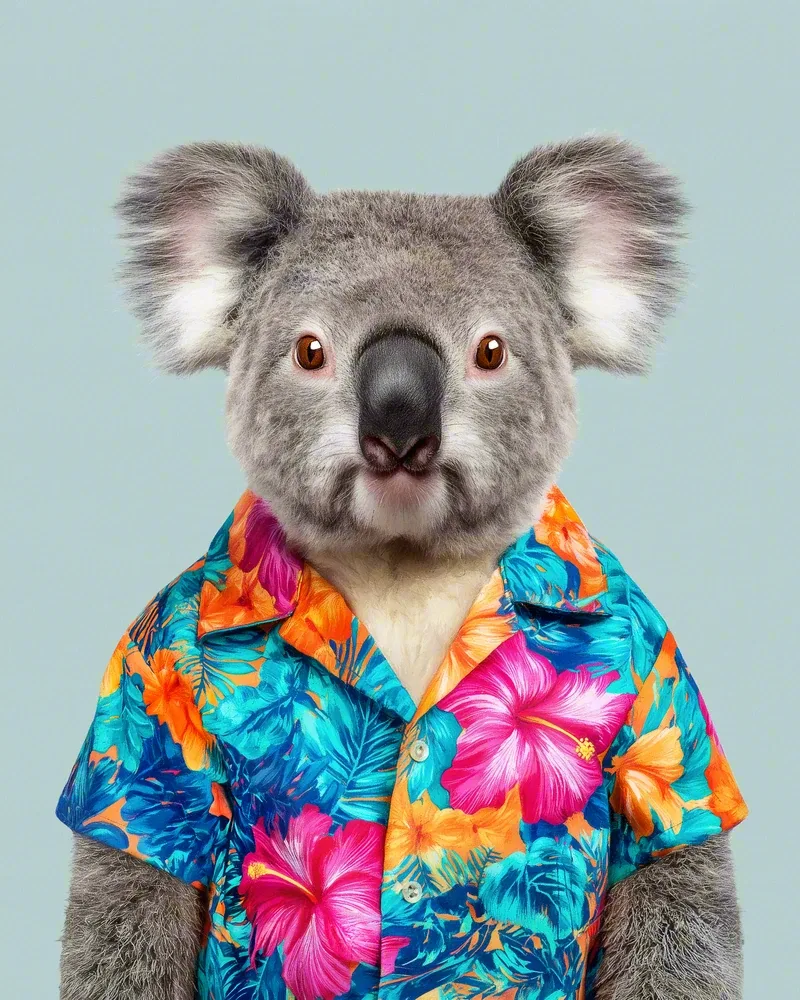
Cooper, Koala — Animal Kinhood portrait by Yago Partal AK · 01 S 31°27′ E 152°44′ Cooper Wauchope, AU PHOTO ©YP · 2026
Animal Kinhood · Wild animals No. 01 / 20 Episode · Cooper
Phascolarctos cinereus

Cooper.

Koala

Look after each other, we're the ones still here.
Add it to your Kinhood.Already part of your Kinhood.
Biography · Block 01 of 03 Koala
Chapters · I–II–III

The story.

I
CH · 01 / 09

Mooorning, Wauchope

At two minutes past six in the morning, Cooper leans into the mic whispering. "Mooorning, Wauchope." He stretches it out, lets it drop low, and out of that small round body in a Hawaiian shirt comes a bellow like a diesel engine that doesn't match his face: anyone who only knows him from the radio pictures him twice the size. When he really laughs, he coughs.

He's a koala-Kin, from Wauchope, Hastings River valley, mid north coast of New South Wales. Never lived anywhere else. Not one move. Breakfast announcer on 2WAY FM, six to nine, a volunteer, not paid a cent. The rest of the day he delivers hardware to cover the rent, and he likes that double life: nobody at the counter would guess the voice on the radio is his until he opens his mouth.

The station lives in the old croquet clubhouse, corner of Bain and Cameron, the lawn still marked out in the grass. The 2WAY sign was hand-painted by a volunteer, the W a bit crooked. The flyscreen door gives a sharp bang when it shuts: the sound his day starts with. And his chair, gaffer tape over a split in the armrest: if he finds it turned away, he swings it back to face the desk before he sits down. He doesn't call it a ritual; he just does it.

II
CH · 02 / 09

Nan's mug

Before he opens the mic, the first cup. Coffee from the Bago Road place, black, near boiling. The mug is brown stoneware with the glaze chipped right where his lip lands: it was Nan's, his grandmother's, and he holds it with both hands like it weighs more. If anyone takes it, he washes it and takes it back.

Those five minutes in the dark, the town asleep and his notebook miles away in its drawer, are the closest thing to faith he has. Giving the valley, at five, a voice that sounds like everything's going to be all right: that's discipline.

As a kid she'd take him out into the bush behind the house, naming the trees for him: this is tallowwood, this grey gum, this swamp mahogany. She taught him to count the named creatures of the valley. She died old, in her own bed, which in this town is nearly a luxury.

III
CH · 03 / 09

The patter

The breakfast patter has a set anatomy the district knows by heart. Thunder-greeting. The weather, with a gag: "gonna be a hot one, slip-slop-slap, ya galahs, I don't want death notices for sunburn on my shift." Then the traffic and travel for a town with no traffic: two utes and a tractor on Hastings River Drive, the Settlement Point ferry running about one ferry late, a cow. Then the birthdays and who's lost a dog.

He learned radio hanging around this same studio as a teenager. Carried tea, coiled cables, learned to read the clock on the wall. They let him stay because his booming voice made the old volunteers laugh. One day a bloke on his way out handed him the headphones with no ceremony — "here, kid, let's see what you do with it" — and gave him the graveyard slot, the shift nobody wanted. At sixteen he was doing the overnight, spinning records for truckies and for no one. He learned something there that's never left him: talking to people you can't see, who might not even be listening, isn't being alone. It's having company in the dark. He still uses those same cans, the cracked headband wrapped in insulation tape. He puts them on and the voice settles into place on its own.

Voiceline · the character’s canonical quote Cooper · Koala
Hover to pause
Mooorning, Wauchope. AK · 01 · Cooper · Wauchope 2025 Slow down — the surname deserves to be said right. Voiceline · Phascolarctos cinereus I run on low power, which isn't the same thing. AK · 01 · Cooper · Wauchope 2025 Mooorning, Wauchope. AK · 01 · Cooper · Wauchope 2025 Slow down — the surname deserves to be said right. Voiceline · Phascolarctos cinereus I run on low power, which isn't the same thing. AK · 01 · Cooper · Wauchope 2025
§ 04 · Objects Open editions · everyday
10 pieces · Print on demand

Take Cooper home.

Biography · Block 02 of 03 Roots
Chapters · IV–V–VI

The roots.

IV
CH · 04 / 09

Slow down, the surname deserves it

And at the end, between a birthday and the church fete, he slips in the births and the death notices without changing his tone. That's the whole of the discipline.

He reads a death notice the way he'd read a birthday. "Slow down — the surname deserves to be said right. Rest easy, mate. You did well." He learned it from his grandmother, on those walks. When she died, Cooper wrote her down with her full name: the only thing he's written out in full in years of a column of tick marks. The next day he read her notice like all the others, and nobody knew it was his. He went home and Dazza had left a fresh gum leaf on his side of the bed.

The town gives him back something he never quite sees. For the older koala-Kin living on their own, his good morning is sometimes the only kind voice they hear, and when he dedicates a song "to whoever's on their own out there this morning," he's talking to someone specific he's picturing. An old girl in the IGA queue grabbed his paw once, looked him dead in the eye and said, "don't ever stop, love, your voice is the only kind thing I hear all day." Cooper played it for a laugh. Inside, something shifted, and he pushed it away, like always: think about it seriously and it makes his head spin.

V
CH · 05 / 09

Red cover, Spirax brand

In the bedside drawer of the granny flat, under the charger cables, there's a spiral notebook. Red cover, Spirax brand, the kind they sell at the servo. Cooper nicks it from the day job and uses it only for this. Two columns in biro: on the left, the ones born; on the right, the ones gone. He doesn't keep totals; he knows by which of the two inks runs out first. Dazza knows the notebook exists and has never opened it: the one serious pact of ten years of marriage, and it's never been spoken out loud.

The count started out of shame, not cause. One morning he read two death notices in a row without knowing they were mother and son from the same litter; the widow rang him afterwards, hurt but kind, with a patience that stung worse than a shout. That night he wrote down the two names, and the notebook stayed. The death notices kept edging out the births, a handful a year, year after year. Not because more people are dying: it's that fewer are left to die.

Cooper delivers screws through neighborhoods where koala-Kin families used to live and now there are big houses with gum-tree-free yards. His grandmother used to quote a number, "there were three thousand-odd of us, love"; today the district's down to about two thousand, and in the Wauchope and Port core barely two hundred and fifty, the strip where he lives, shrunk back toward the river and the old streets near the breakwall.

VI
CH · 06 / 09

A gum leaf on the porch

When one of them dies, the Hastings neighbours leave a fresh gum leaf on the family's porch, no knock; Cooper reading the death notices at seven is that same leaf, laid by everyone at once. And the other way round: when he spots a fresh eucalyptus ribbon on a letterbox — a joey's been born — he gets down out of the van just to note it in the good column. He tells Dazza "good day today," and Dazza, who knows the code, gets out the good beer.

He's no activist. Doesn't go to council meetings or sign letters to the paper. When someone at the pub gets tragic about "the town's dying out," Cooper cuts it off: "yeah, yeah, Macca, very sad. You gonna bowl or do I do it and beat you again? I've already got a funeral Sunday." And he rolls the ball.

He doesn't talk about it because talking about it would turn him into the sad koala of the endangered town, and he wants to be the bloke on the radio who brightens your breakfast. The count is private precisely so his cheer on air is the real thing and not an act. His underlying fear, the one he doesn't quite say even to Dazza, is reading the last koala-Kin death notice one day and finding only silence behind it. His job isn't to grieve it. It's to make the mornings of the ones still here worth waking up for.

Biography · Block 03 of 03 Craft
Chapters · VII–VIII–IX

The present.

VII
CH · 07 / 09

The killer under the teddy bear

There's another Cooper, and he comes out at the bowls club. Still soft-voiced, but a clean coldness comes over him: he quits joking, sizes up the end in silence, reads the curve three plays ahead. "I'll leave this one nice for you. Take your time. I've got all the time in the world." He bowls it perfect and steals the end off you. "Sorry, mate," with zero regret. The softest bloke in town is the deadliest on the green.

He once flattened a Sydney sea-changer who wrote him off for being soft, the teddy-bear smile still intact. He doesn't feel it as a contradiction. Thirty years in the district knowing who's done right and who's done wrong, he files it away, and only bares his teeth on regulation grass.

The one thing that gets to him is gratuitous cruelty: the Sydney bloke who bought the Whitlocks' place, turfed the family out and cut down the gum tree for the view, and now rings the radio to complain about the noise. "Anyway. Let's put another song on."

VIII
CH · 08 / 09

Daz, the kettle

Dazza. Darren to his mother, Daz at home, Dazza on air. Also koala-Kin, which in a shrinking town is no small thing: he found one of his own, and he knows it. Carpentry teacher at the TAFE in Port Macquarie and an all-round handyman; he built the deck and the shelves of the flat. At four, tea. They needle each other for sport, koala versus wombat: "at least I don't dig holes in the yard." "Put the kettle on" means "tell me." The one fight of the decade is the chipped green mug, which Dazza uses to measure screws.

They live in a rented granny flat at the back of someone else's block. Fibro and tin, low ceiling, vinyl lifting from the damp. Cooper calls it the deluxe shed. No aircon: a split Dazza's spent three summers promising to fit next weekend, still in its box, by now a joke neither of them wants to end. The weekly rent is the black hole of the household budget, and Cooper doesn't say the figure out loud, like someone who won't name the sick dog.

And it doesn't get him down. The million-dollar house, the sea change, never entered his idea of a good life. "Nah, mate, nah. Poor in the wallet. In life I'm laughing. Look at me: I've got Daz, I've got the mic, I've got my mug. What more do you want." Not a scrap of irony. The after-lunch nap he doesn't take as laziness either: "I run on low power, which isn't the same thing." That hour on the couch is where he digests what he's read on air: he lies down with a name in his head and gets up having let it go. Dazza respects that morning.

IX
CH · 09 / 09

Must be the heat, mate

In summer his voice changes. It comes out a touch deeper when he says good morning; the meter needles swing into the red and a volunteer learned to drop his gain in January without knowing why. He gets more territorial about the chair and the mug, more possessive of Dazza. He puts it down to the heat. "Must be the heat, mate. That'll be it." He never connects it to anything else, and the not-knowing is part of who he is. Dazza's the only one who notices — "your voice goes deeper in January, did you know that?" — and Cooper went blank, laughed and changed the subject. Those weeks he keeps his hand on the back of Dazza's neck more.

He closes the breakfast show every morning with the same line, in the tone of any old see-you-tomorrow: look after each other, we're the ones still here. See you tomorrow. He drops it like a warm little sign-off and no one in Wauchope knows he means it. He wouldn't admit it either. Then he kills the lights, walks out hollowed at nine, and goes to sleep the morning off. The last image of the day is usually the bedside drawer, which he doesn't open. He just knows it's there. Coffee and get on with it.

§ 07 · Species file Phascolarctos cinereus

About the koala.

Classification
  1. Animalia
  2. Chordata
  3. MammaliaMammals
  4. Diprotodontia
  5. Phascolarctidae
Phascolarctos cinereus (Goldfuss, 1817)
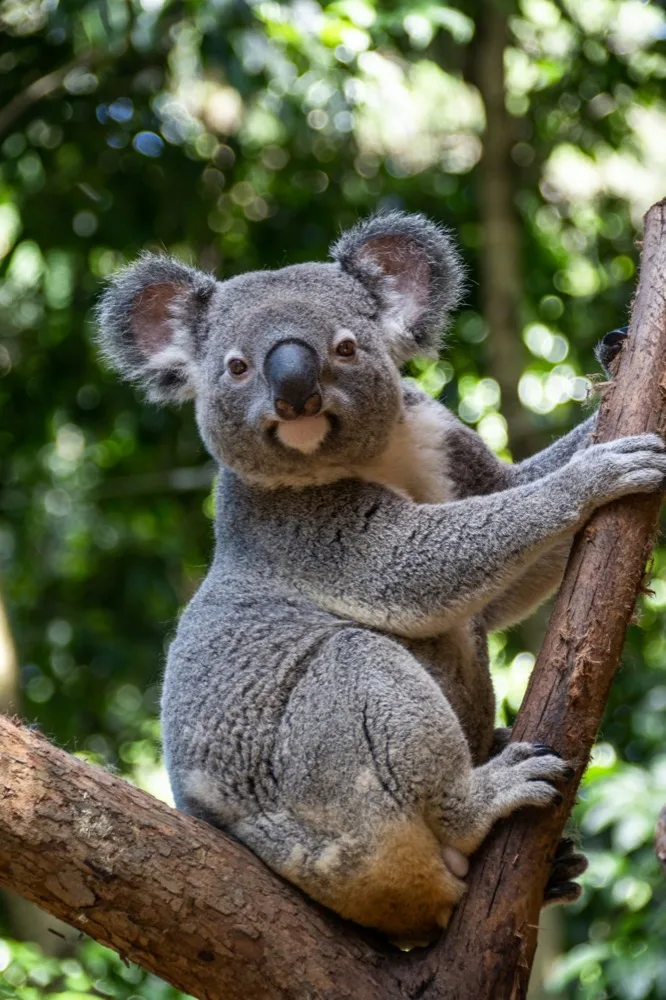
A real koala (Phascolarctos cinereus) sitting on a eucalyptus branch, looking at the camera: reference photo of the species.
The real animal · Phascolarctos cinereus Photo: Tarryn Grignet / Unsplash
Habitat
Eucalyptus forests and coastal woodland of eastern Australia; in the Hastings River valley (NSW) for Cooper.
Diet
Specialist: eucalyptus leaves (it picks around 30 out of more than 600 species), very low in energy and toxic to just about any other animal.
Lifespan
About 13-18 years.
Weight
4-15 kg; 60-85 cm long.
Adaptation
A huge caecum lets it digest the toxic eucalyptus leaf; and it has fingerprints almost identical to ours.
Record
The male bellows far deeper than his size suggests (an extra pair of velar folds); sleeps up to ~20 hours a day.

Conservation status

Global (IUCN)
Vulnerable
Where it lives
Endangered in Queensland, New South Wales and the Australian Capital Territory — jointly listed under the EPBC Act since 12 February 2022 (previously Vulnerable). Cooper lives in that strip.
Population
Estimates vary wildly depending on the method and who's counting. The Australian Koala Foundation puts it at fewer than ~64,000 wild koalas (maybe under 40,000); the Australian Government's expert elicitation (2022) landed at around ~329,000 with steep regional declines. The exact number is uncertain; what nobody disputes is that eastern Australia's populations are in decline.
View the IUCN Red List page

Main threats

  1. Habitat loss: eucalyptus forests cleared for urban sprawl along the east coast.
  2. Climate change: droughts that strip the nutritional value from the leaf, heatwaves and bushfires.
  3. Disease: chlamydia hits New South Wales populations hard.
  4. Road deaths and dogs where the bush runs up against the houses.
Habitat protection and gum-tree reforestation programs, the Australian Koala Foundation's Koala Habitat Atlas, and WWF-Australia's Koalas Forever initiative (goal: double koala numbers by 2050).

Did you know…?

01
A voice impossible for his size

The male koala has an extra vocal organ — a pair of velar folds outside the larynx — that lets him bellow at a frequency up to twenty times lower than his small body should allow: a sound you'd expect from an animal the size of an elephant (Charlton et al., 2013). In Cooper that bellow is his broadcaster's boom.

02
Fingerprints like ours

Koalas have fingerprints — loops, arches and whorls — so much like human ones that under a microscope they're hard to tell apart. It's a case of convergent evolution for gripping branches (research from the University of Adelaide).

03
Two thumbs on each hand

The koala's front paw has TWO opposable digits (the first and second, set against the other three). That double pincer grip holds onto branches so firmly it doesn't let go even in his sleep.

04
Low power

He sleeps up to about 20 hours a day. It's not laziness: the eucalyptus leaf gives so little energy that his body drops to the bare minimum to live on it. Cooper puts it best: "I run on low power, which isn't the same thing."

05
Marsupial, not a bear

The koala isn't a bear: it's a marsupial, a relative of the wombat, and its young — the joey — finishes developing inside the mother's pouch before it faces the world.

06
The invisible threat

Beyond logging and fire, chlamydia hits whole koala populations hard in New South Wales: infections that cause blindness and infertility and speed up the species' decline.

Frequently asked questions

Is the koala endangered?
More than its cuddly reputation lets on. The IUCN lists it as Vulnerable worldwide, and on Australia's east coast — Queensland, New South Wales and the Capital Territory — it's been listed as Endangered since 2022. It's hit by eucalyptus clearing, bushfires, drought and a chlamydia epidemic that leaves whole populations blind and infertile. Cooper lives right in that strip, and that's why his story is, underneath it all, about looking after the ones still here.
Is the koala a bear?
No, even if half the world says "koala bear." It's a marsupial, a cousin of the wombat: the young, the joey, finishes developing inside the mother's pouch before poking its head out. That cuddly little face is a con; underneath, it's a far stranger animal than it looks.
Why does the male koala bellow so deep?
Because he's got an extra vocal organ: a pair of folds outside the larynx that let him drop his pitch up to twenty times lower than his size should allow. Out of a creature you could hold in your arms comes a bellow like a diesel engine. It was the first thing that hooked me about him, and that's how Cooper ended up a radio broadcaster.
Do koalas really have fingerprints like ours?
They do, and it's one of the most baffling things about the animal. They have loops, arches and whorls so much like human ones that they're hard to tell apart under a microscope — and we're not close relatives at all: evolution hit on the same trick on its own for gripping branches. In theory, a koala could leave prints at a crime scene.
How long does a koala sleep, and why?
Up to about twenty hours a day, and it's not because it's lazy. The eucalyptus leaf gives so little energy — and it's toxic to just about any other animal — that the koala idles its body down to live on it. Cooper puts it better than I can: "I run on low power, which isn't the same thing."
What does the koala eat?
Almost nothing but eucalyptus leaves, and not even any old kind: it picks around thirty species out of the more than six hundred that exist. It's such a specialist that the diet is both its superpower and its Achilles heel: take away its tree and it has no plan B. That's a big part of why it does so badly when the bush disappears.
Where do koalas live?
In the eucalyptus forests and coastal woodland of eastern Australia. Cooper is from the Hastings River valley, in New South Wales: a small-town koala, in the same spot his whole life. He's not one to migrate — he's born, lives and dies stuck to his trees — and that's why it hurts him so much when those trees aren't there.
Who is Cooper?
Cooper is a koala from Animal Kinhood, my series of animals who dress and live like people. In his story he voices his town's breakfast radio show, on the east coast of Australia: he's up early, greets the valley with that booming voice and keeps an eye on everyone. Hawaiian shirt, a mug he lends to nobody, and a calm that rubs off on you.
Is Cooper based on a real koala?
The character is made up — the voice, the job, the shirt, all of it comes out of my head — but the animal is koala to the bone, and everything I tell you about its biology is real and verified. I like it when someone who falls for the character walks away knowing true things about the creature: half the point of Animal Kinhood is right there.
What is Animal Kinhood?
It's the series where I've spent years portraying animals as if they were people of their own species: with their clothes, their trade, their character and their place in the world. Each one lives where the real animal lives and carries, without lecturing you, the story of how its species is faring. Cooper is one of them.
Are the portraits real photos or made with AI?
They're digital work. I don't photograph animals in costume, and I don't paint them: I build each portrait on the computer with digital tools — generative ones too — that I steer from start to finish, choosing species, clothing, light and expression until it comes out exactly as I have it in my head. The idea, the choices and the finish are mine; the machine is just another brush.
How can I help koalas?
By backing the people on the ground. The Australian Koala Foundation maintains the koala habitat map and fights to protect it, and WWF-Australia runs its Koalas Forever initiative, aiming to double koala numbers by 2050. The links are right here, in the conservation section of this page.
§ 08 · Conservation two programs · verified
Koala

Help protect this species.

Every purchase helps, but a direct donation does more. Two NGOs with specific programs verified for this species.

No. 01 / 02

Australian Koala Foundation.

Australian Koala Foundation (AKF)

The leading NGO devoted to the koala; it maintains the Koala Habitat Atlas and publishes the most-cited population estimates.

Donate to Australian Koala Foundation
No. 02 / 02

WWF-Australia.

WWF-Australia · Koalas Forever

Koala conservation work through the Koalas Forever initiative, which aims to double koala numbers by 2050.

Donate to WWF-Australia
Animal Kinhood · 20 characters

Twenty names. Twenty stories. Twenty personalities. One same project.

Full catalogue · Drop 01 — Q3 2026 Explore Animal Kinhood