Animal Kinhood Wild animals Endangered
12 min read 9 chapters Live · Andapa
Front-facing portrait of Stan, a young male aye-aye with pale fur on his face and very large amber eyes, his dark ears out to the sides. He wears a black wool beanie pulled down to his ears with a small white skull embroidered on the front, a black leather jacket with spiked studs on the shoulders, a metal zipper and silver buttons, and underneath a red-and-black plaid flannel shirt, buttoned up. Plain celadon green background. AK · 33 S 14°40′ E 49°39′ Stan Andapa, MG PHOTO ©YP · 2026
Animal Kinhood · Wild animals No. 33 / 34 Episode · Stan
Daubentonia madagascariensis

Stan.

Aye-aye

Put it under Solofo's name, I was slow today.
Add it to your Kinhood.Already part of your Kinhood.
Biography · Block 01 of 03 Aye-aye
Chapters · I–II–III

The Fastest Hand in the Row.

I
CH · 01 / 09

Boxes That Didn't Need Moving

A car pulled into the warehouse yard and the foreman looked up from the sorting counter. He asked Stan to go behind the scales, said there were chests that needed shifting. He asked calmly, the way you'd send anyone on an errand. Stan took the first one by the handles and spent two hours moving boxes that were fine where they were.

From back there he could hear the conversation. The buyer talked about moisture and grades; the foreman answered in the voice he uses in front of outsiders, slower, with more yeses in it. When the car started up, Stan went back to the counter and picked up the pile he'd left half done.

He was fifteen. Now, when he hears an engine in the yard, he takes himself round the back before anybody tells him to.

Outside the flowering season he works nights: turning the beans, closing the conditioning chests, staying until dawn, because cured vanilla disappears if the warehouse is left on its own. He moves between the piles with the bulb off and only pulls the switch when something has to go on the sheet.

II
CH · 02 / 09

Two People Can Read the Notebook

Nobody in the crew argues about who pollinates the most flowers. Stan finishes his row and doubles back to help, and anyone who comes in new gets the whole motion from him, slowly, with none of the hard part held back. If someone questions one of his rows he takes real offense. He has raised his voice once in two seasons, and that was why.

At the end of the day he crouches down with the notebook propped on his knee. He counts the rows under his breath, thumb on the paper. He writes his number. He crosses it out with two lines and puts Solofo's over it — his cousin on his mother's side, who pollinates in the same crew and is slower. He closes the notebook before he stands up.

Solofo gets paid for those rows, and with that money he buys the rice for both of them. Two seasons like this and they've never discussed it. Solofo can read that notebook perfectly well.

When the foreman asks, Stan tells him he was slow that day. Sometimes he adds something about whose name he signs things under, chin a little raised, and to the foreman it sounds like cocky street-kid talk. The notebook is swollen with damp and the bottom corner has been eaten away. Every page carries one number crossed out with two lines and another written over it.

III
CH · 03 / 09

Forty Rows and Two Lines

The first time was at seventeen. He had finished forty rows in a single day, the kind of number people in the basin talk about for weeks. He sat on the drum in the yard with the notebook on his knee and wrote his own. He sat there looking at it. Then he crossed it out and put Solofo's over it.

Solofo was three meters away, washing his arms in the big drum, and saw him do it. He dried his hands on his trousers, picked up his own sheet and got on with what he was doing. That night they ate rice in his room, door open because of the heat, and neither of them brought it up.

Stan told the foreman he'd gone slow that day. The count is still there in the notebook, crossed out.

Voiceline · the character’s canonical quote Stan · Aye-aye
Hover to pause
Put it under Solofo's name, I was slow today. AK · 33 · Stan · Andapa 2025 Put it under Solofo's name, I was slow today. Voiceline · Daubentonia madagascariensis Put it under Solofo's name, I was slow today. AK · 33 · Stan · Andapa 2025 Put it under Solofo's name, I was slow today. AK · 33 · Stan · Andapa 2025 Put it under Solofo's name, I was slow today. Voiceline · Daubentonia madagascariensis Put it under Solofo's name, I was slow today. AK · 33 · Stan · Andapa 2025
§ 04 · Objects Open editions · everyday
10 pieces · Print on demand

Take Stan home.

Biography · Block 02 of 03 Roots
Chapters · IV–V–VI

Forty Minutes of Road.

IV
CH · 04 / 09

Drop the Sack and Head Back Down

You get up to his mother's village by the road or by the paddy. As a kid he went by the paddy, mud to his ankles, because his mother took him that way and he thought it was the shortcut. One day it occurred to him to count the minutes and it came out twenty longer. He kept the count to himself.

The post is driven in at the upper crossroads, at the entrance to Ambodiangezoka, and it has stood empty since before he was born. Nobody has pulled it out. Coming up through the paddy it sits off to his right, twenty meters away. Stan goes past two or three times a month and looks straight ahead.

The last time he went into the village he was sixteen. He came up by the paddy, set the sack down on the floor of the doorway and stayed standing with one foot outside, talking from there. His mother put the plate in his hand instead of on the table, the way she always did. He ate standing up, handed the plate back and went down before it got dark.

It ended without a scene. He stopped going up, and that was that. Now they meet at the crossroads, forty minutes further down: Clarisse comes down with the sack over her shoulder, he waits for her sitting on a drum, they hand over whatever they've brought and she asks him whether he's eating. He tells her yes. At no point are the two of them sitting down at the same time.

V
CH · 05 / 09

Another Name at the Top of the Sheet

The row leader job is handed out by the office at the end of the season, going off the sheet. Stan has been passed over last season and the one before, always for the same reason: his name turns up scattered along the margins, in between somebody else's lines, and the name at the very top belongs to someone who does less.

The second time he found out at midday, in the drying yard, back to the sun and the paper held close to his face so he could read it. He folded the sheet and put it in his trouser pocket, in with the slivers. That night he closed the notebook the same as any other night.

Out loud he says they gave it to someone else, and that's true. The other half of the sentence he keeps.

VI
CH · 06 / 09

What He Says at the End of the Day

He tells whoever's carrying the sheet quietly and with no further explanation: "Put it under Solofo's name, I was slow today." He has cleared his row before the rest of them and the ones standing there know it.

He doesn't say much and he cuts things short. He answers before you've finished the question and then stays quiet for longer than he needs to. If somebody notices something of his and says so, his hand goes to the edge of the beanie, he lets out a "you can tell" and gets on with the next chest. The crew reads it as the bad temper of a nineteen-year-old.

As for his own people, in the crew there's him and that's it. The ones from his village are scattered across the valley and hardly ever get together; the ones who know each other know each other from work. Nor is there any figure for how many of them there are: somebody from outside tried more than thirty years ago, came out with a margin so wide it was no use for anything, and that number is still being repeated. Stan tells it the way you'd say nobody has ever got round to counting.

He hasn't got a place of his own either. He has five places where they let him sleep and he rotates between them with no fixed logic: the concrete-floored room Solofo has behind his father's shop, a corner of the drying shed, the long bench in the warehouse. During flowering he stays five weeks straight in the drying shed, because at half past four you have to be on your feet.

Biography · Block 03 of 03 Craft
Chapters · VII–VIII–IX

His Father's Sliver.

VII
CH · 07 / 09

Fourteen Flowers Before Nine

His father, Fidèle, got him out of bed before dawn when he was eleven and took him up to a plot in flower. He put a bamboo sliver in his hand and showed him the motion: lift the rostellum, press the pollinium against the stigma, let go and move to the next one. The vanilla flower opens for a single morning and around here there is nothing to pollinate it, so it has to be married by hand, flower by flower, while it's open. Stan did fourteen that dawn and fell asleep sitting between two rows before nine.

It was Fidèle who told him where the motion came from. An enslaved twelve-year-old boy worked it out on an island to the east, in 1841, and it has been done the same way ever since. Stan repeats it in those same words to anyone who comes in new to the crew, and then gets back to his row.

He left school at twelve, halfway through the flowering, because in flowering you get paid by the flower. Nobody at home argued. He went back twice in January and those were the last times. He reads well and writes just enough, which is what a notebook needs.

At fourteen he started finishing his row before everyone else and doubling back to help. They gave him a nickname, which didn't last, and they raised his daily rate, which did. Fidèle is still at the same warehouse, on the scalding and the conditioning boxes, and he is the person Stan sees on the most days of the year. The sliver he uses is the one his father gave him: worn smooth by so much thumb and a little shorter than it was. He carries three more in his pocket, new, never used.

VIII
CH · 08 / 09

He Taps Three Times, Then Answers

Before he answers a question, Stan taps whatever's in front of him three times with his middle finger: the lid of a chest, the sorting counter, the metal panel on the cart, the door frame. He goes so fast that nobody manages to count it properly, and while he does it his ears swing round toward the spot he's tapped. Before he climbs the ladder in the yard, he knocks on the rung.

Then he says which chest is badly packed. He gets it right. If they ask him how he knows, he looks at the chest as though the answer were written on the outside and says you can tell. If they press him, he says the lid sounds odd with the damp. If they press harder: "It's just that I get nervous, that's all."

For two seasons now the woman on the scales has been stacking the doubtful chests beside him, without telling him why and without changing her face. He touches them as he goes past and she sets aside the ones he touches twice.

He is terrible at the scalding. With the boilers lit and the water at a rolling boil he grades worse than someone who started yesterday, and it shows from the doorway. He blames the steam, which genuinely does bother him.

He's always chewing something. The end of a spent vanilla stem, until it's frayed; a hood drawstring; the pull on a zipper. He switches objects without noticing.

IX
CH · 09 / 09

Nobody Touches the Beanie

A black wool beanie bought at a stall selling clothes out of the bale, with a white skull embroidered on the front, the size of a fingernail. Fanja, his sister, stitched it in one afternoon with the white thread from the machine she sews on at the market, and she didn't ask him why he wanted a skull. He keeps it on in the steam of the scalding and at midday out in the yard. His ears stay outside it, at the sides. "Nobody touches the beanie," he says, as a joke. Nobody has touched it more than once.

The jacket came out of another bale, stiff, with one sleeve scuffed that is still scuffed. The studs on the shoulders he put in himself, one at a time, backs on the inside, with a borrowed pair of pliers. Underneath he always wears the same red-and-black plaid flannel shirt, buttoned to the top; he has another one just like it and rotates the two.

He put all of that together at sixteen and has worn it the same way ever since. He shows Fanja his hands when the soda from the scalding splits his knuckles open; she gives him something from the pharmacy and says nothing.

Today he cleared his row before anyone else. Out in the yard, crouched down, notebook on his knee, he counts under his breath with his thumb on the paper. He writes his number, crosses it out and puts Solofo's over it, and puts the notebook away before he stands up.

§ 07 · Species file Daubentonia madagascariensis

About the aye-aye.

Classification
  1. Animalia
  2. Chordata
  3. MammaliaMammals
  4. Primates
  5. Daubentoniidae
Daubentonia madagascariensis
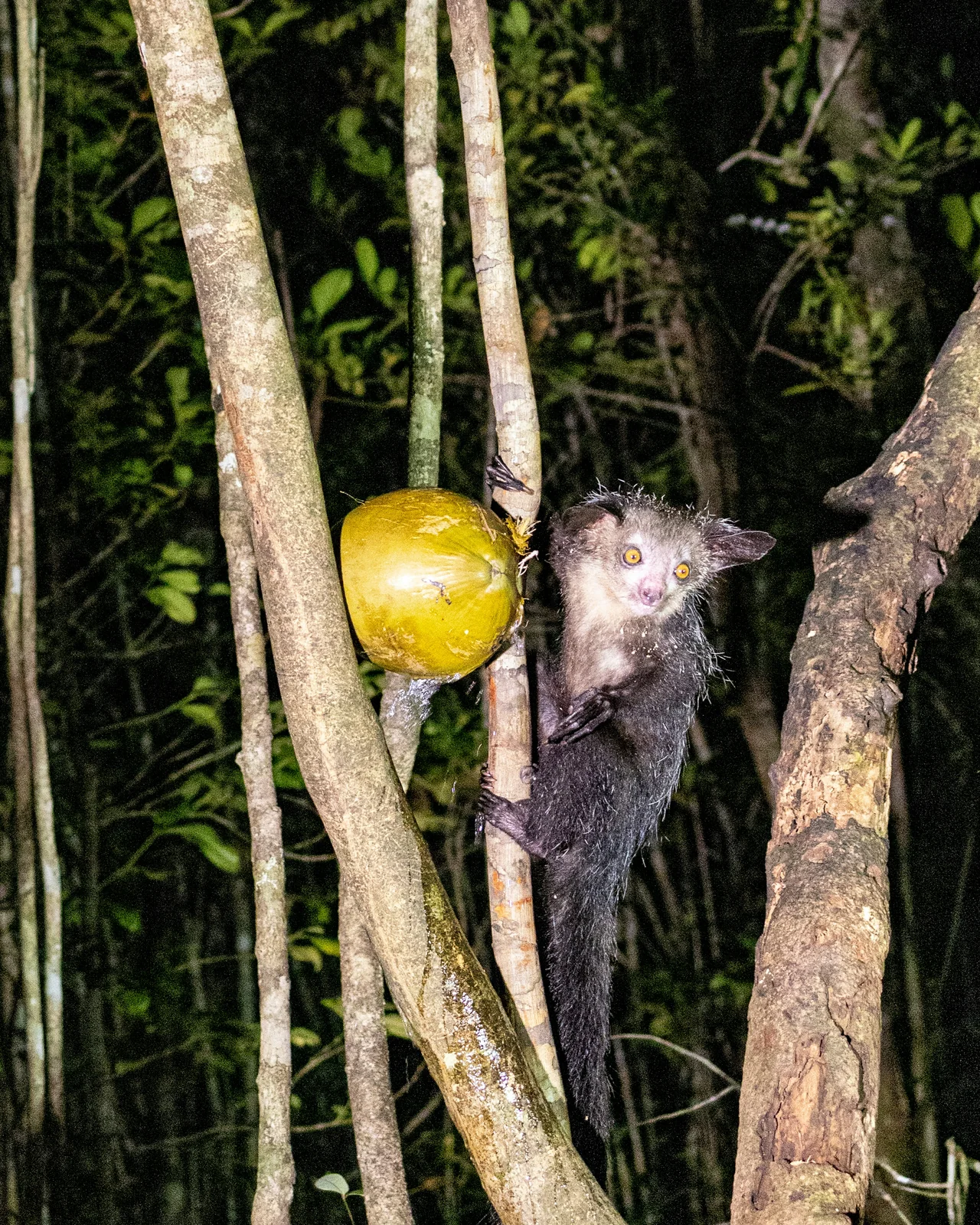
Aye-aye (Daubentonia madagascariensis) in the wild
The real animal · Daubentonia madagascariensis Foto: Rafael Peier (@rafaelpeier) / Unsplash (Unsplash License)
Habitat
Lowland tropical rainforest along the east coast of Madagascar and dry deciduous forest in the west and northwest, in a distribution fragmented into pockets: Masoala, Nosy Mangabe, Mananara Nord —where Aye-Aye Island, or Île Roger, works as a semi-wild sanctuary—, Daraina in the far north, and populations further south such as Ranomafana. It is endemic to Madagascar and lives nowhere else.
Diet
An omnivore specialized in wood-boring beetle grubs, which it extracts from trunks and branches. It rounds out the diet with ramy seeds (Canarium), nectar, fungi and birds' eggs. Near cultivated land it also eats coconut and sugar cane, which puts it in direct conflict with whoever works the plot.
Lifespan
In the wild it is reckoned at around twenty years, a figure poorly documented because the species is so elusive. In captivity, more than twenty-six years have been recorded at the Duke Lemur Center, in North Carolina.
Weight
Between 2 and 2.7 kg, with a body 36 to 44 cm long and a densely furred tail almost as long as the body itself or longer, up to 60 cm. It shows no marked sexual dimorphism in size.
Adaptation
The third digit is skeletal, far longer and thinner than the rest, and has a ball-and-socket joint at the base that gives it an exceptional range of movement. With it the animal taps the wood up to eight times a second while it aims its ears — large and bare — to listen for the echo of cavities occupied by grubs. Then it gnaws the bark open with its incisors and pulls the grub out with that same digit.
Record
The longest-lived individual recorded in captivity passed twenty-six years at the Duke Lemur Center, in North Carolina, the highest longevity mark known for the species to date.

Conservation status

Global (IUCN)
Endangered
Where it lives
The pressure varies a great deal from one region of Madagascar to another. In the north and center it suffers systematic killing tied to the fady taboo, whereas in the south — in Ranomafana, for instance, where the species was scientifically documented much later — cultural persecution is far weaker or practically nonexistent. The attitude study published in 2021 in People and Nature also shows that very different positions coexist within a single district.
Population
Unknown. The species is elusive, nocturnal and thin on the ground, which has ruled out any reliable count. The old estimates, from 1992, spoke of between one thousand and ten thousand individuals, a figure considered obsolete today. More recent fieldwork has widened the known range, but the population remains fragmented into isolated pockets and the overall trend is regarded as declining.

Main threats

  1. Deforestation from logging and slash-and-burn shifting agriculture (tavy), which fragments and shrinks its forest habitat.
  2. Persecution and direct killing driven by the fady taboo, which in some regions requires the animal to be killed on sight.
  3. Opportunistic hunting and conflict with whoever works the plot over damage to coconut and sugar cane crops.
  4. Genetic isolation of ever smaller populations as the forest breaks up into scattered patches.
There is no recovery plan with population targets, not least because there is no baseline figure to start from. What there is is protected land where the species is on record —Masoala, Nosy Mangabe, Mananara Nord with Aye-Aye Island as a semi-wild sanctuary, Daraina, Marojejy and Anjanaharibe-Sud— and fieldwork that has steadily widened the known range. In Stan's own region, SAVA Conservation has been combining forest restoration, research and community education since 2011, which is the approach that goes after deforestation and the fady at the same time.

Did you know…?

01
The Finger That Listens

The aye-aye has a skeletal middle finger it uses as a probe and as radar. It taps the wood up to eight times a second and swivels its ears, bare and enormous, to listen for the echo of grubs hidden inside the trunk. Then it bites the bark open and pulls the grub out with that same finger. No other primate forages like that.

02
Rodent Teeth in a Primate's Body

It is the only primate in the world with ever-growing incisors, with no closed root, exactly like a rodent's. They keep coming for its whole life and wear down as it gnaws bark and hard shells. That convergence threw the first eighteenth-century naturalists off so badly that they classified it as a kind of squirrel.

03
A Sixth Finger Nobody Described Until 2019

In 2019, a team led by the anatomist Adam Hartstone-Rose described a small pseudo-thumb in the aye-aye's wrist, an extra sesamoid bone hidden under the skin and with its own fingerprint. It helps the animal grip the branch firmly while the other five digits, including that very long middle finger, do the fine work.

04
It Sleeps in a Sphere of Branches

It is strictly nocturnal and spends the whole day asleep in a spherical nest of interwoven branches and leaves, built as high as twenty meters up in the canopy. Each individual keeps as many as five or six alternate nests inside its territory and rarely uses the same one two nights running.

05
The Animal Blamed for Misfortune

Across much of northern and central Madagascar there is the fady, the belief that seeing an aye-aye, or having one point at you with its long finger, brings illness or death to the village; traditionally it was killed and hung from a post at the edge of town so that a traveler would carry the misfortune away with them. The belief is not uniform: in the south, as in Ranomafana, the taboo barely existed, and a field study published in 2021 found that, although 47 % of the people surveyed held a negative attitude, more than half were neutral or even positive.

06
Its Name Was Born From a Cry of Surprise

According to the French naturalist Pierre Sonnerat, who described the species in 1782, the name «aye-aye» comes from the exclamation of astonishment his Malagasy guides let out when they came across the animal. The scientific name, Daubentonia madagascariensis, honors the naturalist Louis-Jean-Marie Daubenton. In Madagascar it is also called aiay or hay-hay depending on the region, and in German Fingertier, «finger animal».

Frequently asked questions

Where does the aye-aye live?
Only in Madagascar. It occupies tropical rainforest on the east coast and dry forest in the west and northwest, in a fragmented distribution that includes Masoala, Nosy Mangabe, Mananara Nord, Daraina in the far north and pockets further south such as Ranomafana. It lives in no other country.
What is the long finger for?
For tapping and for extracting. It percusses the wood up to eight times a second and aims its ears at the echo to locate the cavities where beetle grubs are. When it finds one, it opens the bark with its incisors and pulls the grub out with that same finger. It is a foraging technique no other primate uses.
Why is it killed in some parts of Madagascar?
Because of the fady, a taboo found above all across the north and center of the island, according to which seeing an aye-aye, or having one point at you with its finger, brings illness or death to the village. Traditionally it was killed and hung on a post at the edge of town. It is not a uniform belief: in the south it barely exists, and a field study published in 2021 found that more than half of the people surveyed held a neutral or even positive attitude.
Is it endangered?
Yes. The IUCN Red List classifies it as Endangered and regards its population trend as declining. That does not mean anyone knows how many are left: there is no reliable count, and the only figure in circulation, from 1992, is considered obsolete.
Is it a monkey?
No. It is a strepsirrhine primate, from the same broad group as the lemurs, and not a monkey. It is also the only living member of its family, Daubentoniidae, after the extinction of its larger relative Daubentonia robusta: a lineage so singular that it gets an infraorder of its own. The first naturalists who saw it, in the eighteenth century, went as far as classifying it as a squirrel because of its incisors.
How long does an aye-aye live?
In the wild it is reckoned at around twenty years, although the figure is poorly documented because the species is hard to follow. In captivity, more than twenty-six years have been recorded at the Duke Lemur Center, the highest known mark.
§ 08 · Conservation three programs · verified
Aye-aye

Help protect this species.

Every purchase helps, but a direct donation does more. Three NGOs with specific programs verified for this species.

No. 01 / 03

SAVA Conservation.

Duke Lemur Center · SAVA Conservation

A project running since 2011 in the SAVA region, in northeastern Madagascar, the district where Stan lives and very close to the aye-aye's actual range in Daraina and Masoala. It trains local conservation leaders and combines forest restoration, lemur research and community environmental education.

Donate to SAVA Conservation
No. 02 / 03

MFG.

Madagascar Fauna and Flora Group

A consortium of zoos, aquariums and botanical gardens working on the ground in eastern Madagascar, with its own stations at Parc Ivoloina and the Betampona Nature Reserve, on the same eastern coastal strip where the aye-aye lives, running lemur reintroduction and habitat protection programs.

Donate to MFG
No. 03 / 03

Planet Madagascar.

Planet Madagascar

A Canadian charity focused on community-based lemur conservation in Madagascar. It combines restoration of forest corridors, improvements to the living conditions of Malagasy communities, and education aimed at curbing illegal hunting.

Donate to Planet Madagascar
Animal Kinhood · 34 characters

Thirty-four names. Thirty-four stories. Thirty-four personalities. One same project.

Full catalogue · Drop 01 — Q3 2026 Explore Animal Kinhood